<?xml version="1.0" encoding="utf-8"?><feed xmlns="http://www.w3.org/2005/Atom" ><generator uri="https://jekyllrb.com/" version="4.4.1">Jekyll</generator><link href="https://dragomirsec.com/feed.xml" rel="self" type="application/atom+xml" /><link href="https://dragomirsec.com/" rel="alternate" type="text/html" /><updated>2026-10-06T19:30:20+00:00</updated><id>https://dragomirsec.com/feed.xml</id><title type="html">DragomirSec</title><subtitle>Security &amp; privacy tools. Dragons guard treasure, I guard data.</subtitle><entry><title type="html">Red Team Deep Dive: DistCC Remote Code Execution</title><link href="https://dragomirsec.com/red-team/2026/09/10/distcc-rce.html" rel="alternate" type="text/html" title="Red Team Deep Dive: DistCC Remote Code Execution" /><published>2026-09-10T12:00:00+00:00</published><updated>2026-09-10T12:00:00+00:00</updated><id>https://dragomirsec.com/red-team/2026/09/10/distcc-rce</id><content type="html" xml:base="https://dragomirsec.com/red-team/2026/09/10/distcc-rce.html"><![CDATA[<h2 id="assignment-scope">Assignment Scope</h2>

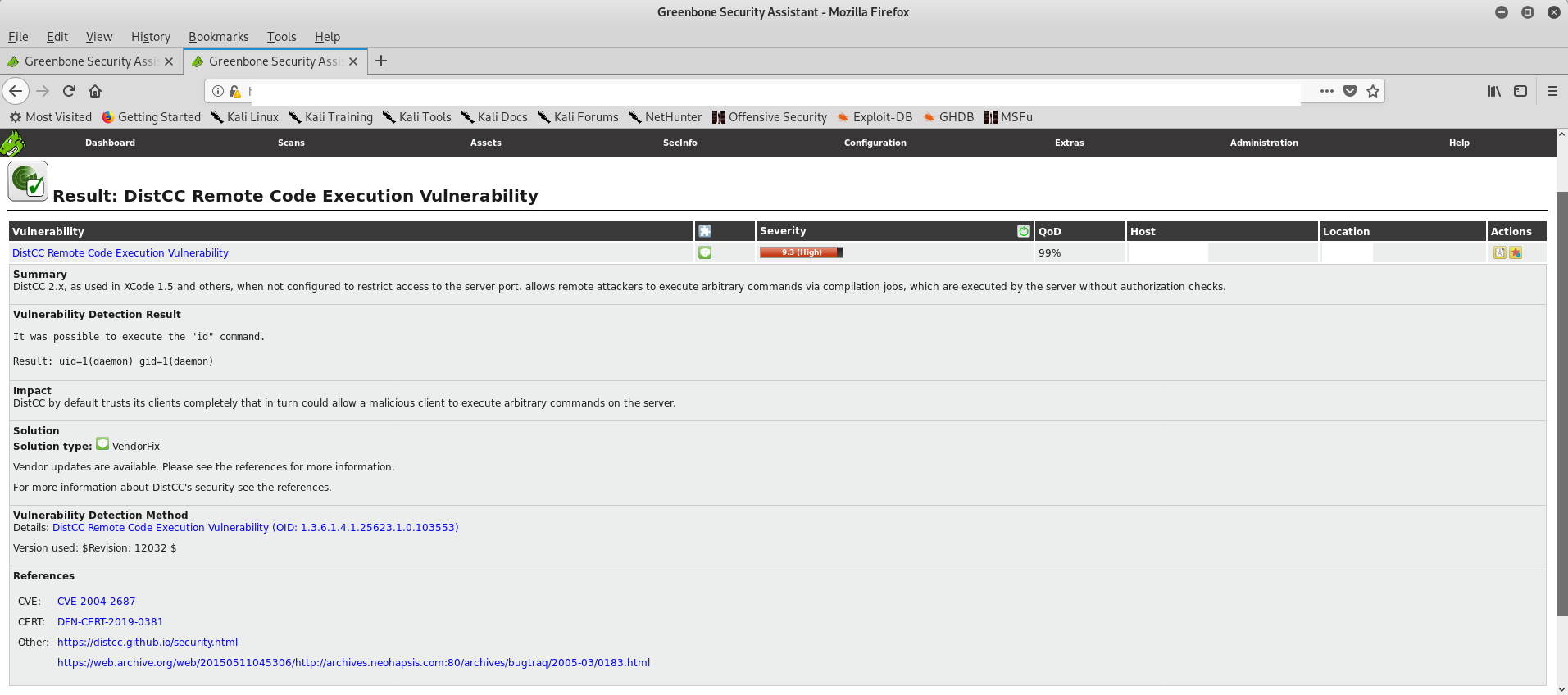
<p>For this assignment, my red team is deep-diving into the vulnerabilities found in this scenario’s client machine. Each of us chose an individual vulnerability from our OpenVAS scan of the client’s machine — I picked the DistCC Remote Code Execution Vulnerability, CVE-2004-2687.</p>

<h2 id="vulnerability-overview">Vulnerability Overview</h2>

<p>DistCC is a software development tool for speeding up compilation by distributing the computing workload across servers over the network. By default, DistCC 2.x does not restrict access to the server port. This allows attackers to execute arbitrary commands remotely, effectively acting as a developer using the tool.</p>

<h2 id="cve-details">CVE Details</h2>

<table>
  <thead>
    <tr>
      <th>Field</th>
      <th>Value</th>
    </tr>
  </thead>
  <tbody>
    <tr>
      <td>CVE</td>
      <td>CVE-2004-2687</td>
    </tr>
    <tr>
      <td>CVSS</td>
      <td>9.3</td>
    </tr>
    <tr>
      <td>Severity</td>
      <td>High</td>
    </tr>
  </tbody>
</table>

<p>DistCC 2.x, as used in Xcode 1.5 and others, when not configured to restrict access to the server port, allows remote attackers to execute arbitrary commands via compilation jobs, which are executed by the server without authorization checks [2].</p>

<h2 id="screenshot-4a--openvas-findings">Screenshot 4a — OpenVAS Findings</h2>

<p><img src="/assets/images/OpenVAS.png" alt="OpenVAS scan findings showing CVE-2004-2687" /></p>

<h2 id="why-this-matters-to-the-customer">Why This Matters to the Customer</h2>

<p>The DistCC vulnerability presents a serious threat to Hotel Dorsay’s business continuity and compliance. If exploited, a malicious actor could compromise:</p>

<ul>
  <li><strong>Confidentiality:</strong> of the hotel’s guests, employees, and possibly their financial information</li>
  <li><strong>Integrity:</strong> of the hotel’s IT and communication systems by controlling and/or altering door lock passkeys, among other things</li>
  <li><strong>Availability:</strong>  by encrypting the system, essentially performing a denial-of-service (DoS) attack</li>
</ul>

<h2 id="nmap-verification">Nmap Verification</h2>

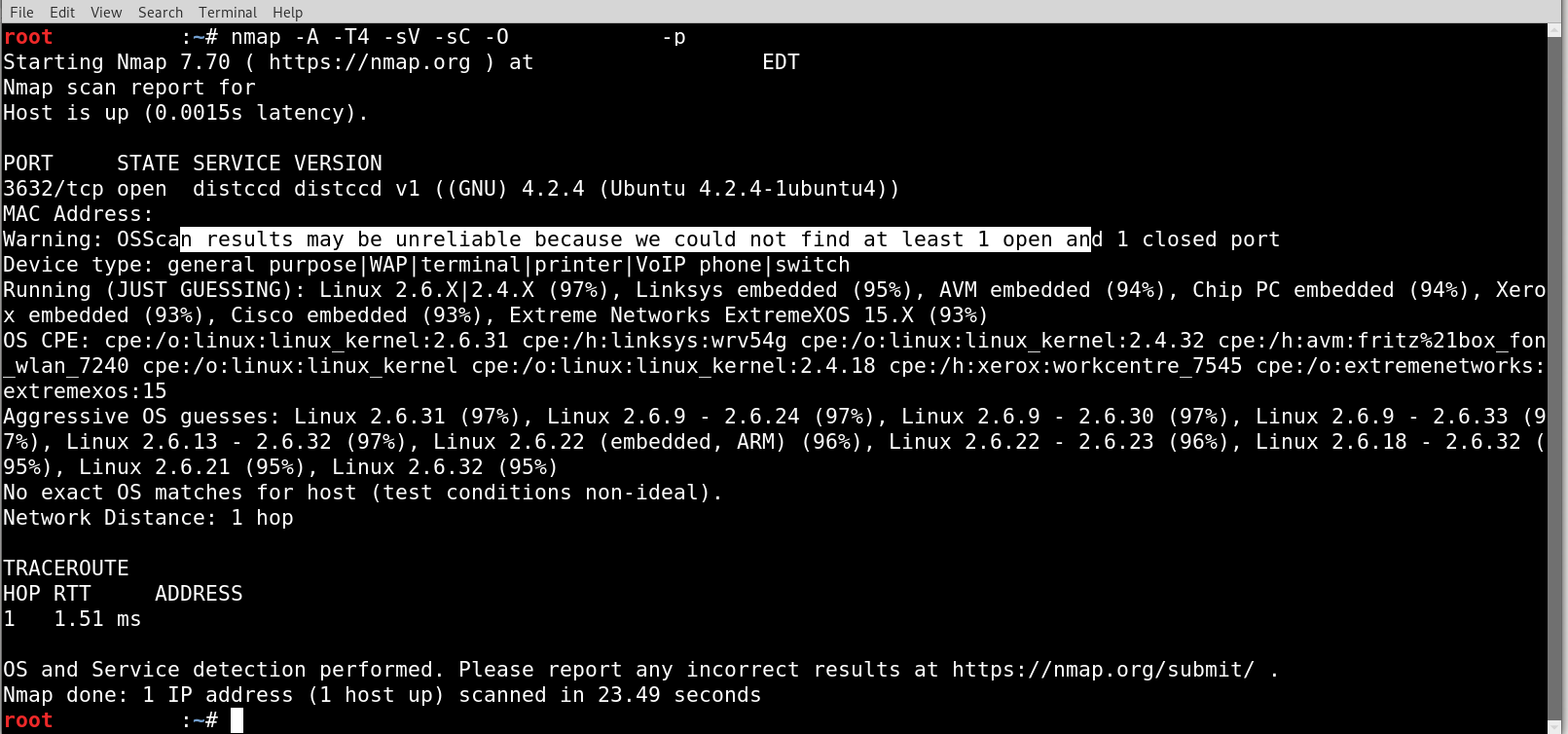
<p>To verify the vulnerability, I performed a targeted Nmap scan. This command uses <code class="language-plaintext highlighter-rouge">-A</code> for an aggressive scan, <code class="language-plaintext highlighter-rouge">-T4</code> for faster scanning speed, <code class="language-plaintext highlighter-rouge">-sV</code> for version detection, <code class="language-plaintext highlighter-rouge">-sC</code> to run Nmap’s default scripts, and <code class="language-plaintext highlighter-rouge">-O</code> for operating system detection.</p>

<div class="language-bash highlighter-rouge"><div class="highlight"><pre class="highlight"><code>nmap <span class="nt">-A</span> <span class="nt">-T4</span> <span class="nt">-sV</span> <span class="nt">-sC</span> <span class="nt">-O</span> &lt;target-ip&gt; <span class="nt">-p</span> 3632
</code></pre></div></div>
<h2 id="screenshot-4b--nmap-verbose-output">Screenshot 4b — Nmap Verbose Output</h2>

<p><img src="/assets/images/nmapscanV2.png" alt="Nmap verbose output confirming DistCC on port 3632" /></p>

<h2 id="analysis">Analysis</h2>

<p>The Nmap scan confirms the OpenVAS vulnerability finding. The scan shows that port 3632/tcp is open and running DistCC as a service. It also reveals additional information: the service protocol version, that the client machine is running Ubuntu, and the system’s MAC address.</p>

<h2 id="remediation">Remediation</h2>

<p>The quickest and easiest fix is updating to the current release of DistCC 3.3+ [1]. If the current version of the service is mission-critical, implementing an allowlist on the server, or using a VPN to reach the service, would mitigate the vulnerability.</p>

<h2 id="references">References</h2>

<p>[1] M. Pool, <em>distcc: Distributed Builds for C, C++ and Objective C</em> [Online]. Available: <a href="https://github.com/distcc/distcc">https://github.com/distcc/distcc</a> [Accessed: Sep. 10, 2026].</p>

<p>[2] National Institute of Standards and Technology, “CVE-2004-2687 Detail,” <em>National Vulnerability Database</em>. [Online]. Available: <a href="https://nvd.nist.gov/vuln/detail/cve-2004-2687">https://nvd.nist.gov/vuln/detail/cve-2004-2687</a> [Accessed: Sep. 10, 2026].</p>]]></content><author><name></name></author><category term="red-team" /><category term="cve-2004-2687" /><category term="distcc" /><category term="openvas" /><category term="nmap" /><category term="rce" /><summary type="html"><![CDATA[Red team analysis of CVE-2004-2687: DistCC 2.x RCE via unrestricted server port, verified with OpenVAS and Nmap.]]></summary></entry></feed>